This article is from the Australian Property Journal archive
A mid-year pause in interest rate rises will help trigger a recovery of capital city dwelling prices in 2023 that will be led by Sydney and Perth, according to SQM Research’s Christopher’s Housing Boom and Bust Report.
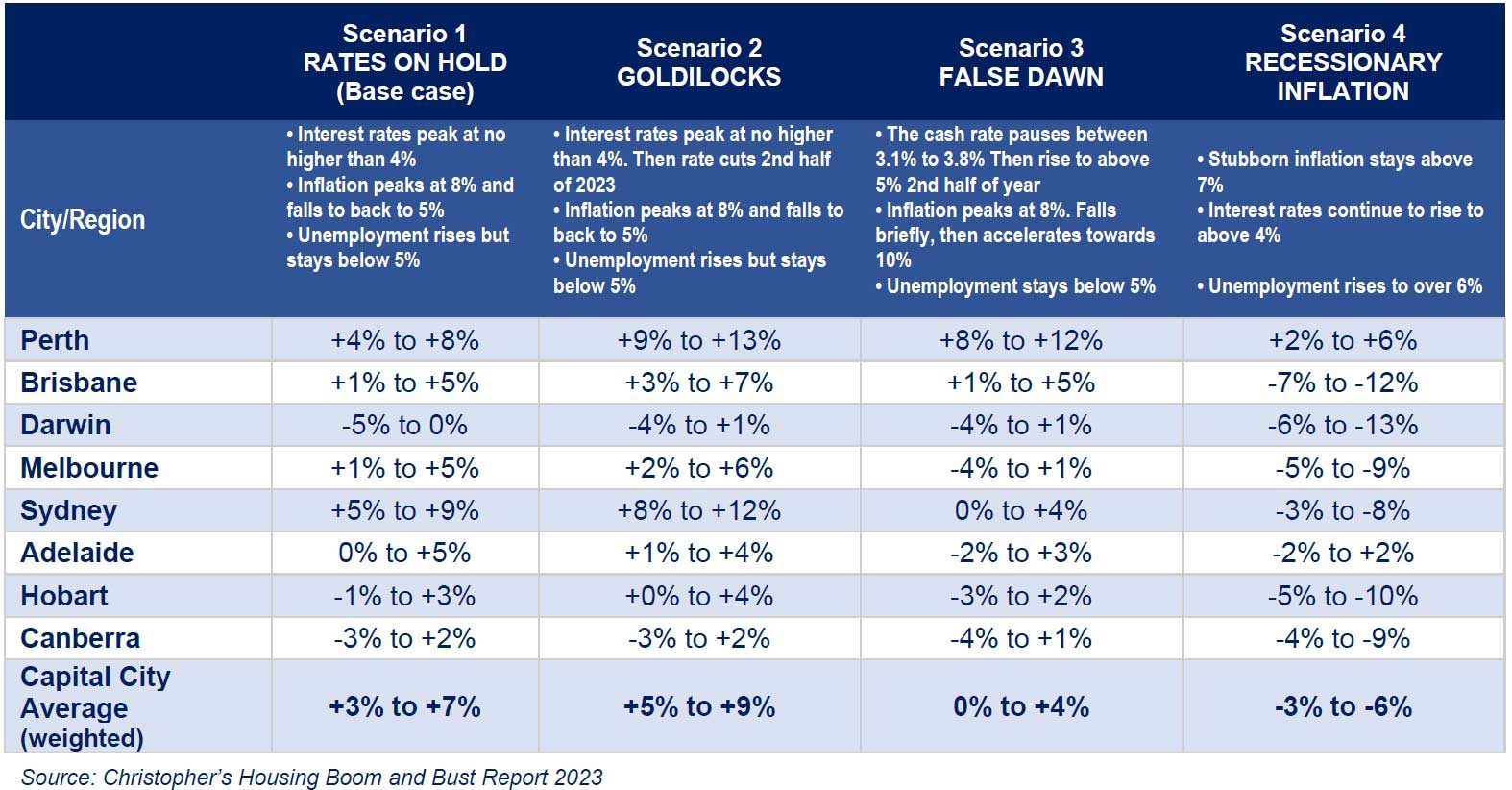
The report’s base case scenario suggests that interest rates peak no higher than 4%, while inflation peaks at 8% and falls back to 5% and unemployment rises but stays below 5%.
An interest rate hike pause is expected by June with the official rate to stay on hold for the rest of the year.
National dwelling prices in the base case scenario will rise between 3% to 7%, with Sydney to grow by 5% to 9%. The recovery in Sydney will be driven by the surge in underlying demand for residential property as a result of the rise in overseas arrivals, the return to the office, the existing shortage of rental accommodation, the new stamp duty and land tax changes and the expected ongoing strength of the Sydney economy, according to the report.
There have been signals that Sydney’s eastern suburbs market has already entered into this recovery, particularly for free-standing houses. SQM’s leading indicators note a moderate rise in the auction clearance rate for Sydney, particularly for those eastern suburbs
Melbourne is also forecast to enter into recovery with prices tipped to rise between 1% to 5%. Perth is expected to rise between 4% to 8% on the back of strong rises in employment and positive interstate migration.
“No doubt it will be a very challenging year for the RBA to walk their tight-rope and pull off a soft landing for the Australian economy. However, contrary to current popular opinion, I believe they will manage to do just that,” said Louis Christopher, managing director of SQM Research said.
“The combination of previous lessons learnt by our Central Bank, a renewed focus on data plus our connection to the Asian tiger economies will mean we likely see an economic slowdown but not a recessionary hard landing. That is not to see it won’t be a close call. No question, there will be major uncertainties,” he said.
A flood of forced sales in the housing market is unlikely if the official interest rate remains at or below 4%.
“There is of course a risk the RBA may need to go further. If they do then the risks of a hard landing in the economy do substantially rise and thus, a hard landing in the housing market would also occur.”
SQM Research’s “recessionary inflation” scenario would see house prices on average fall between 3% and 6%, including falls of 7% to 12% in Brisbane and 6% to 13% in Darwin, and 5% to 10% in Hobart. Melbourne could fall 5% to 9% and Sydney by 3% to 8%.
The other extreme case is the “goldilocks” scenario, in which interest rates peak at no higher than 4%, inflation peaks at 8% and falls back to 5%, and unemployment rises but stays below 5%. In this scenario, prices rise by between 5% on average, including rises of between 9% and 13% in Perth, 8% and 12% in Sydney, 3% to 7% in Brisbane and 2% to 6% in Melbourne.
The “false dawn” scenario lands in between the base case and recessionary inflation scenarios, with a rise of 0% to 4% nationally, although Perth would see a rise of 8% to 12% with modest movement elsewhere.
SQM Research is forecasting initial ongoing strong rises in rents for most capital cities, however a peak in the capital city rental market is tipped later in 2023 as dwelling completions rise, slower housing formation and renters turning themselves into first home buyers. Asking rents are forecast to rise between 8% to 13%.