This article is from the Australian Property Journal archive
THE return to the office remained at a standstill in August, as workers sought to avoid the final phase of the Omicron and flu waves.
Occupancy in Australia’s two largest markets were barely changed during the month after taking a dive in July, with Sydney inching upwards to 53% and Melbourne to just 39%, according to the latest data from the Property Council of Australia.
Adelaide saw the largest rise, with occupancy climbing from 64 to 71%, while Brisbane increased from 53 to 57% and Canberra from 61 to 64%.
Perth was the only market to witness a drop, dipping from 71 to 69%.
Property Council CEO Ken Morrison said despite only small increases in occupancy, the data reveals a resilient office market, with peak days remaining high across most of the nation. Adelaide’s peak was 83%, with low of 59%, and Perth and Canberra recorded peaks of 78% and respective lows of 60% and 33%.
However, in Melbourne, peak days were still at only 51%, with low days seeing just 22% of workers at their CBD desks.
Sydney peak days were at 67% and low days were 35%.
“In the previous survey for July we saw occupancy levels go backwards for the first time in six months, so to see the August figures hold steady or nudge slightly higher in most capitals, despite COVID and flu cases as well as industrial action in Sydney, is a solid outcome,” Morrison said.
“It’s fair to say Melbourne’s occupancy at 39% remains a concern, but you would hope that starts to lift again as the months get warmer and the omicron wave recedes,” he said.
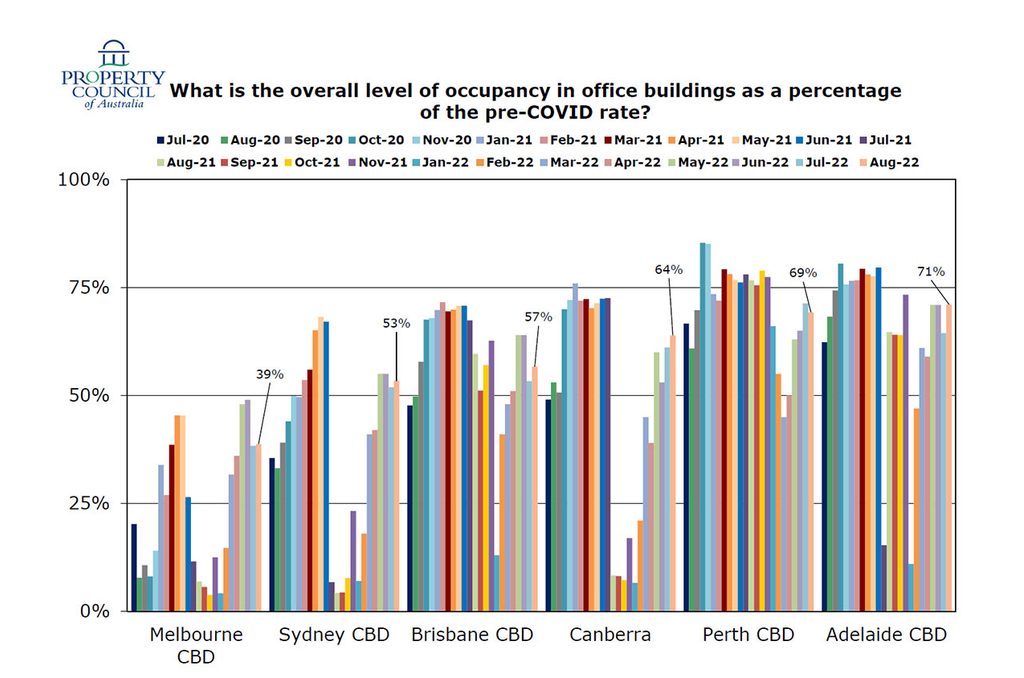
A preference for greater flexibility including working from home was a major driver of occupancy levels, according to the survey, increasing from 48 to 64%. Health concerns surrounding COVID and flu were also a key factor, but fell from 30 to 15%, while public transport concerns were down slightly to 12%.
The proportion of respondents who expect a material increase in occupancy levels lifted again to three months or longer, which would potentially see the return to work en masse delayed until after the summer.
“People are the lifeblood of CBDs, and we don’t yet have enough of them back in our city centres to support our ecosystems of small businesses that call our CBDs home,” Morrison said.
“With spring approaching and the Omicron wave having peaked, the recovery momentum towards a new normal should resume.”